
Combination reactions and combustion
What this lesson covers
- Combination reactions, where reactants join into one product
- Why metal plus non-metal gives an ionic compound and non-metal plus non-metal gives a covalent one
- Combustion of hydrocarbons, and the heat and light it gives out
- The products of complete and incomplete combustion, and why carbon monoxide is dangerous
- Metals burning in oxygen
- Lab tests that identify carbon dioxide, water, oxygen and hydrogen
Combination: two or more reactants, one product
- In a combination reaction, the reactants join up to make a single new substance.
- The general pattern is A + B → AB.
- You can spot one from the equation: several things on the left, exactly one formula on the right.
- Many combination reactions start from elements, so they are the main way compounds are made from scratch.
What kind of compound forms
- When a metal combines with a non-metal, the metal hands electrons to the non-metal, so the product is ionic.
- When two non-metals combine, they share electrons, so the product is covalent.
- This means the elements you start with predict how the product is bonded, and therefore how to write and name it.
- At Kapuni in Taranaki, nitrogen from the air is combined with hydrogen to make ammonia, the first step in making urea fertiliser for NZ farms.
| Reactants | Balanced equation | Product bonding |
|---|---|---|
| sodium + chlorine | 2Na + Cl₂ → 2NaCl | ionic |
| iron + sulfur | Fe + S → FeS | ionic |
| carbon + oxygen | C + O₂ → CO₂ | covalent |
| sulfur + oxygen | S + O₂ → SO₂ | covalent |
| nitrogen + hydrogen | N₂ + 3H₂ → 2NH₃ | covalent |
Worked example: magnesium and oxygen
- Predict the product of magnesium reacting with oxygen, then write a balanced equation.
- metal + non-metalso the product is ionic
- Mg²⁺ and O²⁻, so MgO+2 and −2 cancel one to one
- Mg + O₂ → MgOO: 2 on the left, 1 on the right
- Mg + O₂ → 2MgOO balanced; now Mg is 1 and 2
- 2Mg + O₂ → 2MgO
- left: 2 Mg, 2 O; right: 2 Mg, 2 O
Combustion: burning with oxygen
- Combustion is a fast reaction between a fuel and oxygen that releases energy as heat and usually light.
- Many fuels are hydrocarbons: compounds made only of hydrogen and carbon, such as methane (CH₄) in natural gas and propane (C₃H₈) in BBQ bottles.
- Natural gas from Taranaki fields heats homes and has been burned at Huntly power station to generate electricity.
- The energy comes from forming new, strong bonds in the products, which releases more energy than was needed to break the bonds in the reactants.
- Because energy flows out to the surroundings, combustion is exothermic.
Complete combustion
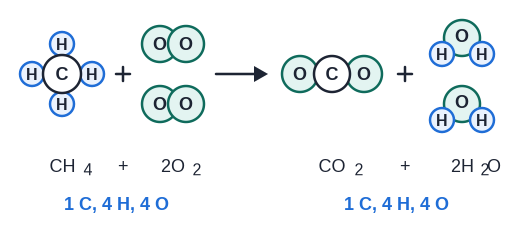
- With plenty of oxygen, every carbon atom ends up in carbon dioxide and every hydrogen atom in water.
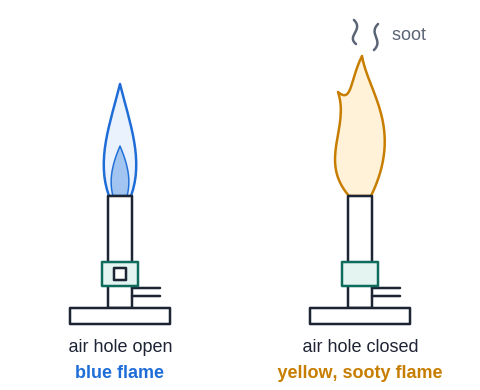
- The flame is blue and clean, with no soot.
- Complete combustion releases the most energy from the fuel.
- For methane: CH₄ + 2O₂ → CO₂ + 2H₂O.
| Element in fuel | Ends up in |
|---|---|
| carbon | carbon dioxide, CO₂ |
| hydrogen | water, H₂O |
Chemistry bench
Worked example: propane burning completely
- Propane + oxygen → carbon dioxide + water
- Balance carbon first, then hydrogen, and oxygen last because O₂ appears on its own.
- C₃H₈ + O₂ → CO₂ + H₂Ounbalanced skeleton
- C₃H₈ + O₂ → 3CO₂ + H₂O3 carbon atoms in propane
- C₃H₈ + O₂ → 3CO₂ + 4H₂O8 hydrogen atoms make 4 water molecules
- oxygen on the right: 3 × 2 + 4 × 1 = 10so 5 O₂ molecules are needed
- C₃H₈ + 5O₂ → 3CO₂ + 4H₂O
- left: 3 C, 8 H, 10 O; right: 3 C, 8 H, 10 O
Try it: balance the combustion
Incomplete combustion
- When oxygen runs short, some carbon cannot reach CO₂. You still get water, but the carbon ends up spread across soot (solid carbon), carbon monoxide and some CO₂.
- The flame turns yellow and smoky, and soot blackens anything held in it.
- Less energy is released, so the fuel is wasted.
- Carbon monoxide has no colour or smell and stops blood carrying oxygen. This is why gas heaters, BBQs and generators must never be used in closed rooms.
- One possible equation for methane: 2CH₄ + 3O₂ → 2CO + 4H₂O.
| Complete | Incomplete | |
|---|---|---|
| Oxygen supply | plenty | limited |
| Bunsen air hole | open | closed |
| Flame | blue, hard to see | yellow, smoky |
| Products | CO₂ + H₂O | H₂O + C, CO and CO₂ |
| Energy released | more | less |
Metals can burn too
- Combustion is not only for fuels. Some metals burn fiercely once heated in oxygen.
- Magnesium ribbon burns with a blinding white light and leaves white magnesium oxide powder. Never look straight at it.
- Fine steel wool burns with orange sparks and turns into iron oxide, the reason sparklers spark.
- These are combination reactions as well as combustion: a metal and oxygen join into one product, an oxide.
- Because there is no carbon or hydrogen, no CO₂ or water forms.
How to identify the products
- You cannot see most gases, so chemists use tests that give a clear, visible result.
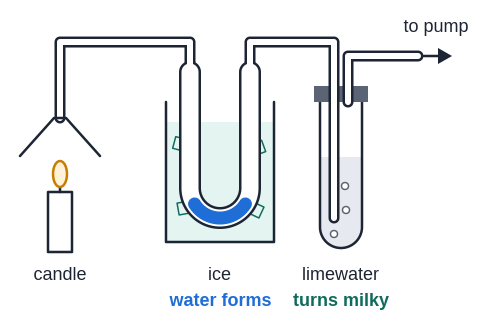
- Limewater is the standard test for carbon dioxide: bubble the gas through it and it turns milky.
- Water condensing on a cold surface can be confirmed with cobalt chloride paper or anhydrous copper sulfate.
- Indicators such as universal indicator show whether a product is acidic, neutral or basic.
| Product | Test | Positive result |
|---|---|---|
| carbon dioxide | bubble through limewater | clear to milky |
| water | blue cobalt chloride paper | blue to pink |
| water | white anhydrous copper sulfate | white to blue |
| oxygen | glowing splint | splint relights |
| hydrogen | lit splint | squeaky pop |
Try it: burn, bond and test
A controlled test: does air supply change combustion?
- Question: does closing the Bunsen burner's air hole change how well the gas burns?
- Change one variable: the air hole, fully open or fully closed.
- Measure: the time to heat 100 mL of water from 20 °C to 60 °C, and whether soot appears on the bottom of the beaker.
- Keep the same: the gas tap setting, the beaker, the volume and starting temperature of the water, and the height of the beaker above the burner.
- Repeat each condition three times. A faster heating time and a clean beaker with the hole open would show complete combustion releases more energy and makes no soot.
Spotting these reactions in everyday life
- Look for the pattern, not the setting: one product from several reactants means combination, a fuel reacting with oxygen means combustion.
- Some reactions fit both labels, such as charcoal or magnesium burning.
| Everyday example | Reaction type | Products |
|---|---|---|
| Gas hob or BBQ with a blue flame | complete combustion | CO₂ + H₂O |
| Candle with a smoky yellow flame | incomplete combustion | soot, CO, CO₂, H₂O |
| Car engine running on petrol | combustion | CO₂, H₂O, some CO |
| Sparklers on Guy Fawkes night | combustion and combination | metal oxides |
| Iron gate slowly rusting | combination (slow, with oxygen and water) | hydrated iron oxide |
Common mistakes
- Methane burns to make carbon dioxide and hydrogen.The hydrogen atoms combine with oxygen, so burning methane fully gives carbon dioxide and water.
- Incomplete combustion makes carbon monoxide instead of water.Water still forms, because the hydrogen burns easily; only the carbon ends up as soot and carbon monoxide as well as some carbon dioxide.
- Burning magnesium gives off carbon dioxide and water like any fuel.Magnesium contains no carbon or hydrogen, so the only product is magnesium oxide.
- Balancing propane, I wrote C₃H₈ + 5O → 3CO₂ + 4H₂O.Oxygen gas is always O₂, so the oxygen count of 10 atoms means 5O₂.
Steel wool combining with oxygen
You need: a plain steel wool pad, vinegar, a tall, narrow drinking glass, a shallow bowl of water, a few drops of food colouring, a marker pen or tape, kitchen gloves
- Wearing gloves, soak a small ball of steel wool in vinegar for one minute, then squeeze it out. The vinegar strips the protective coating off the iron.
- Push the ball right to the bottom of the dry glass so it stays wedged there when the glass is turned over.
- Add food colouring to the bowl of water, turn the glass upside down and stand it in the water, then mark the water level on the side.
- Leave it undisturbed and mark the level again after one hour, a few hours and the next day.
- Look for the steel wool turning orange-brown and the water rising about one fifth of the way up the air space: oxygen from the air has combined with the iron to make iron oxide, so that much gas is gone.
Safety: Steel wool breaks into fine splinters that cut skin and can get into eyes, so wear gloves, keep your hands away from your face, and wash your hands when you finish.
Your turn
Write a balanced equation for calcium combining with oxygen, and say whether the product is ionic or covalent.
Balance the complete combustion of ethane: C₂H₆ + O₂ → CO₂ + H₂O
A camping stove has a yellow, sooty flame. Name two products besides water and explain the cause.
Gas from a burning candle is bubbled through limewater, which turns milky. What does this show?
Why is burning magnesium classed as both combustion and combination?
A student puts a lit splint into a test tube of gas from a reaction and hears a squeaky pop. Which gas is in the tube?
A family runs a gas heater in a closed caravan overnight. Why is this dangerous?
Students time how long a Bunsen burner takes to heat 100 mL of water with the air hole open, then closed. Which must they keep the same?
Show answer
1. 2Ca + O₂ → 2CaO; ionic, because calcium is a metal and oxygen a non-metal. 2. 2C₂H₆ + 7O₂ → 4CO₂ + 6H₂O: 4 C, 12 H and 14 O on each side (doubling avoids a half O₂). 3. Any two of soot (carbon), CO and CO₂; the burner is short of oxygen, so combustion is incomplete. 4. Carbon dioxide is a product, so the candle wax contains carbon. 5. It reacts with oxygen and releases heat and light (combustion), and two reactants form one product, magnesium oxide (combination). 6. Hydrogen, because a lit splint giving a squeaky pop is the test for hydrogen. Oxygen relights a glowing splint, and carbon dioxide turns limewater milky. 7. With little fresh air the oxygen runs short, so combustion is incomplete and makes carbon monoxide. It has no colour or smell and stops blood carrying oxygen. 8. The gas tap setting, because it is a variable that could change the heating time. The air hole is the variable being changed, and the heating time and soot are what is measured.
Reactants, Products and Leftovers
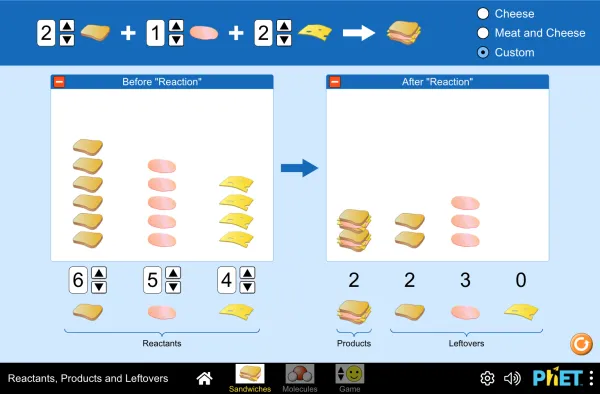
Full screen · PhET Interactive Simulations, University of Colorado Boulder, CC BY 4.0
Recap
- Combination: several reactants form one product, A + B → AB.
- Metal with non-metal gives an ionic product; non-metal with non-metal gives a covalent one.
- Combustion is a fuel reacting with oxygen, releasing heat and often light.
- Complete combustion of a hydrocarbon gives only CO₂ and H₂O; incomplete combustion also gives soot and toxic CO.
- Metals such as magnesium and iron can burn, forming oxides.
- Limewater detects CO₂; cobalt chloride paper detects water.
Challenge
A fuel with the unknown formula CₓHᵧ burns completely in oxygen. The balanced equation is 2CₓHᵧ + 9O₂ → 6CO₂ + 6H₂O. (a) Find x and y. (b) Show that the fuel molecule cannot contain any oxygen atoms. (c) Which two lab tests would show the products, and what would you see?
Hint
Work backwards: every carbon atom on the right came from the 2 fuel molecules, and so did every hydrogen atom. For (b), count the oxygen atoms on both sides and see if any are left over for the fuel.
Answer
(a) x = 3 and y = 6, so the fuel is C₃H₆. (b) The 9 O₂ supply 18 oxygen atoms and the products hold exactly 18, so none can come from the fuel. (c) Limewater turns from clear to milky (carbon dioxide); blue cobalt chloride paper turns pink, or white anhydrous copper sulfate turns blue (water).
Step by step
- The right side has 6 carbon atoms, all from 2 fuel molecules, so each has 3.
- The right side has 6 × 2 = 12 hydrogen atoms, so each fuel molecule has 6.
- Oxygen on the right is 6 × 2 + 6 × 1 = 18 atoms, and 9 O₂ give exactly 18.
- If the fuel had oxygen, the left would have more than 18, so the fuel is a hydrocarbon.
- Limewater tests for carbon dioxide; cobalt chloride paper or anhydrous copper sulfate tests for water.
Full working
- 2x = 6, so x = 3carbon atoms
- 2y = 6 × 2 = 12, so y = 6hydrogen atoms
- right: 6 × 2 + 6 × 1 = 18 Ooxygen in the products
- left: 9 × 2 = 18 O from O₂all the oxygen is accounted for
- left: 6 C, 12 H, 18 O; right: 6 C, 12 H, 18 Ocheck
- C₃H₆, no oxygen in the fuel; limewater goes milky, cobalt chloride goes pink
A gas heater is run in a small room with the window shut. Measurements show that for every 4 methane molecules burned, only 6 oxygen molecules are used, and all the hydrogen ends up as water. (a) How many oxygen atoms are left for the carbon once the water has formed? (b) If all the carbon ends up as one product, which product is it: carbon dioxide, carbon monoxide or soot? Write the balanced equation. (c) Explain why this is more dangerous for the people in the room than a heater making soot.
Hint
4 CH₄ hold 4 C and 16 H. Work out how many water molecules 16 H make and how many O atoms that uses. Then share the oxygen atoms left among the 4 carbon atoms: 2 each means CO₂, 1 each means CO, 0 means soot.
Answer
(a) 4 oxygen atoms. (b) Carbon monoxide: 4CH₄ + 6O₂ → 4CO + 8H₂O, which simplifies to 2CH₄ + 3O₂ → 2CO + 4H₂O. (c) Carbon monoxide has no colour or smell and stops the blood carrying oxygen, so people cannot notice it, while soot is visible and blackens things.
Step by step
- Four methane molecules contain 4 carbon atoms and 16 hydrogen atoms.
- 16 hydrogen atoms make 8 water molecules, which use 8 oxygen atoms.
- Six O₂ molecules supply 12 oxygen atoms, so 12 − 8 = 4 are left.
- Four oxygen atoms for four carbon atoms is one each, so the carbon becomes CO.
- CO is invisible and odourless and blocks oxygen transport in the blood, which is why heaters must not be used in closed rooms.
Full working
- 4CH₄: 4 C, 16 Hcount the fuel's atoms
- 16 H → 8H₂O, using 8 Ohydrogen burns to water
- 6O₂ = 12 O, and 12 − 8 = 4 O leftoxygen left for carbon
- 4 O for 4 C = 1 O per C, so COone oxygen each
- left: 4 C, 16 H, 12 O; right: 4 C, 16 H, 4 + 8 = 12 Ocheck
- 4CH₄ + 6O₂ → 4CO + 8H₂O, carbon monoxide
A ball of steel wool (pure iron) with a mass of 2.80 g is burned completely on a balance, and the iron oxide formed has a mass of 4.00 g. An iron atom is 56 times as heavy as a hydrogen atom and an oxygen atom is 16 times as heavy. (a) What mass of oxygen joined the iron? (b) Use the atom masses to find the ratio of iron atoms to oxygen atoms in the oxide, and write its formula. (c) Write a balanced equation for the reaction. (d) What charge must each iron ion have in this ionic compound?
Hint
Mass of oxygen = oxide minus iron. To compare numbers of atoms, divide each mass by the mass of one atom (56 for iron, 16 for oxygen), then simplify the ratio to whole numbers. Oxygen gas is O₂ when you balance. Oxide ions are O²⁻.
Answer
(a) 1.20 g. (b) Fe : O = 2 : 3, so the formula is Fe₂O₃. (c) 4Fe + 3O₂ → 2Fe₂O₃. (d) +3, so the ion is Fe³⁺.
Step by step
- The extra mass on the balance is oxygen from the air that combined with the iron.
- Dividing each mass by its atom mass gives numbers in proportion to how many atoms there are.
- 0.05 : 0.075 is the same as 2 : 3, so two iron atoms for every three oxygen atoms.
- Balance oxygen with the lowest common multiple of 2 and 3, which is 6, then balance iron last.
- Three O²⁻ give −6, shared between two iron ions, so each iron ion is +3.
Full working
- oxygen = 4.00 − 2.80 = 1.20 gmass of the oxide minus the iron
- iron: 2.80 ÷ 56 = 0.05; oxygen: 1.20 ÷ 16 = 0.075relative numbers of atoms
- 0.05 : 0.075 = 2 : 3divide both by 0.025
- Fe + 3O₂ → 2Fe₂O₃6 O on each side
- 4Fe + 3O₂ → 2Fe₂O₃4 Fe on each side
- 3 × (−2) = −6, and −6 ÷ 2 irons = +3 eachcharges cancel
- Fe₂O₃, 4Fe + 3O₂ → 2Fe₂O₃, Fe³⁺