
Chemical bonding: ions, ionic bonds and covalent bonds
What this lesson covers
- The difference between an element, a compound and a molecule
- Reading a chemical formula: which atoms, and how many of each
- How metals lose electrons to become positive ions and non-metals gain them to become negative ions
- Why opposite charges hold an ionic compound together, and how to balance the charges to write its formula
- Polyatomic ions such as carbonate and nitrate, which act as one charged group
- How non-metal atoms share electron pairs in a covalent bond
- The conventions for writing word and symbol equations
Elements and compounds
- An element is made of only one kind of atom, so every atom in a lump of pure copper is a copper atom.
- A compound forms when atoms of two or more different elements are joined by chemical bonds.
- Water is a compound: every particle has hydrogen and oxygen bonded together in a fixed ratio.
- A compound behaves nothing like the elements it came from. Sodium is a soft, explosive metal and chlorine is a poisonous gas, but sodium chloride is table salt.
- A mixture is different again: its parts are not bonded, so they can be separated by physical methods such as filtering or evaporating.
| Substance | Element, compound or mixture? | Why |
|---|---|---|
| Copper (Cu) | Element | one kind of atom |
| Water (H₂O) | Compound | H and O bonded in a 2 : 1 ratio |
| Sodium chloride (NaCl) | Compound | Na and Cl bonded in a 1 : 1 ratio |
| Seawater | Mixture | salt dissolved in water, not bonded to it |
What counts as a molecule
- A molecule is a small, separate group of atoms held together by bonds.
- Some molecules contain only one element. The oxygen and nitrogen you breathe are O₂ and N₂ molecules, made of two identical atoms each.
- Other molecules contain different elements, so they are also compounds. Sulfur dioxide (SO₂) from the vents at Rotorua and sulfuric acid (H₂SO₄) are examples.
- So every molecule of a compound is a compound, but not every molecule is a compound.
| Formula | Name | Molecule of an element or a compound? |
|---|---|---|
| H₂ | hydrogen | element |
| N₂ | nitrogen | element |
| SO₂ | sulfur dioxide | compound |
| H₂SO₄ | sulfuric acid | compound |
Reading a chemical formula
- Each symbol stands for one element, and a capital letter always starts a new symbol, so Co is cobalt but CO is carbon and oxygen.
- A small number written below the line (a subscript) counts the atom just before it.
- No subscript means one atom of that element.
- Argon is written Ar because its atoms float around alone, not bonded to anything.
| Formula | Atoms in one particle | Total atoms |
|---|---|---|
| Ar | 1 argon | 1 |
| O₂ | 2 oxygen | 2 |
| H₂O | 2 hydrogen, 1 oxygen | 3 |
| CO₂ | 1 carbon, 2 oxygen | 3 |
| H₂SO₄ | 2 hydrogen, 1 sulfur, 4 oxygen | 7 |
Modelling elements and compounds
- Give each element its own colour of bead or modelling clay ball, for example white for hydrogen, red for oxygen and black for carbon.
- Build H₂ with two white balls and O₂ with two red balls: one colour in each model means an element.
- Build H₂O and CO₂: two or more colours joined together means a compound.
- Now put loose white and red balls in a cup without joining them. That models a mixture, because nothing is bonded.
- A good check: if you can name the substance by counting colours in one joined group, your model shows its formula.
Ions: when electrons move from one atom to another
- Atoms are most stable when their outer (valence) shell is full, like the noble gases.
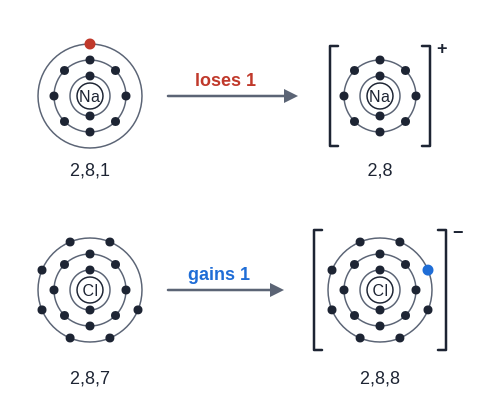
- A metal atom has only a few valence electrons, so it is easiest to lose them. Sodium (2,8,1) loses one electron to become Na⁺ (2,8).
- Losing negative electrons leaves more protons than electrons, so the metal ion is positive. Positive ions are called cations.
- A non-metal atom is a few electrons short of a full shell, so it gains them. Chlorine (2,8,7) gains one to become Cl⁻ (2,8,8).
- Gaining electrons makes the ion negative. Negative ions are called anions.
- The charge equals the number of electrons lost or gained, so the group in the periodic table predicts it.
| Atom | Electron arrangement | Change | Ion | Ion name |
|---|---|---|---|---|
| Na | 2,8,1 | loses 1 | Na⁺ | sodium ion |
| Mg | 2,8,2 | loses 2 | Mg²⁺ | magnesium ion |
| Al | 2,8,3 | loses 3 | Al³⁺ | aluminium ion |
| O | 2,6 | gains 2 | O²⁻ | oxide ion |
| Cl | 2,8,7 | gains 1 | Cl⁻ | chloride ion |
| S | 2,8,6 | gains 2 | S²⁻ | sulfide ion |
Periodic table
Ionic bonds hold opposite charges together
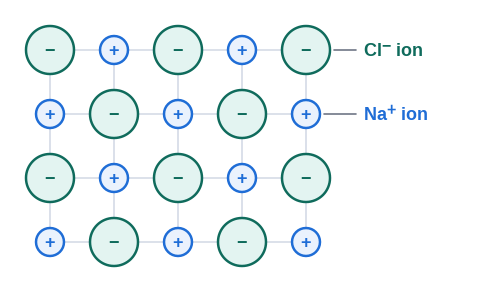
- Positive and negative ions attract each other strongly. That electrostatic attraction is the ionic bond.
- An ionic compound is not made of separate molecules. Millions of ions stack in a repeating 3D pattern called a lattice.
- The whole compound has no overall charge, so the positive and negative charges must cancel exactly.
- This is why sodium chloride is NaCl (one +1 for one −1) but magnesium chloride is MgCl₂ (one +2 needs two −1).
- The formula of an ionic compound therefore shows the simplest ratio of ions, not a molecule.
Try it: ions that cancel
Polyatomic ions: a group with one charge
- Some ions are made of several atoms bonded together, and the whole group carries the charge.
- The group never splits up in a formula, so it is treated like a single ion.
- When you need more than one of the same polyatomic ion, put the group in brackets and write the number outside, as in Ca(NO₃)₂.
- Most polyatomic ions are negative. Ammonium, NH₄⁺, is the common positive one.
| Ion | Formula | Charge |
|---|---|---|
| hydroxide | OH⁻ | −1 |
| nitrate | NO₃⁻ | −1 |
| carbonate | CO₃²⁻ | −2 |
| sulfate | SO₄²⁻ | −2 |
| ammonium | NH₄⁺ | +1 |
Chemistry bench
Worked example: the formula of aluminium oxide
- Aluminium is a metal and oxygen is a non-metal, so the compound is ionic.
- Find each ion's charge, then choose how many of each so the total charge is zero.
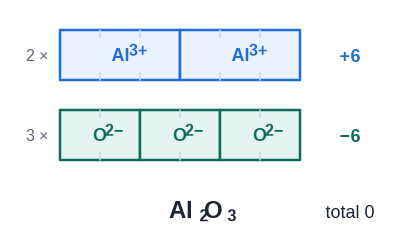
- Al³⁺ and O²⁻Al loses 3 electrons, O gains 2
- lowest common multiple of 3 and 2 is 6both charges must reach 6
- 2 × (+3) = +6two aluminium ions
- 3 × (−2) = −6three oxide ions
- +6 + (−6) = 0neutral overall
- Al₂O₃
Worked example: a formula with a polyatomic ion
- Calcium nitrate is a common fertiliser, used on orchards and market gardens.
- Treat nitrate as one unit and balance the charges exactly as before.
- Ca²⁺ and NO₃⁻calcium loses 2; nitrate is a −1 group
- 1 × (+2) = +2one calcium ion
- 2 × (−1) = −2so two nitrate ions are needed
- CaNO₃₂wrong: it reads as 32 oxygen atoms
- Ca(NO₃)₂brackets keep the nitrate group whole
Covalent bonds: sharing instead of transferring
- When two non-metals meet, both want to gain electrons, so neither will give any away.
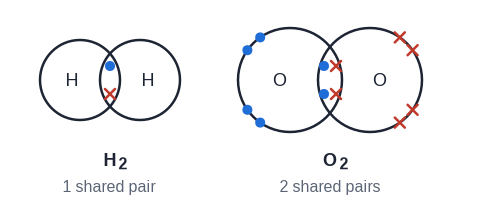
- Instead they each put electrons into a shared pair that sits between the two atoms. One shared pair is a single covalent bond.
- In H₂, each hydrogen shares its one electron, so both atoms count two electrons in their first shell, which is full.
- Oxygen needs two more electrons, so in O₂ the atoms share two pairs: a double bond.
- Covalent bonding makes molecules, such as H₂O, CO₂ and CH₄.
| Molecule | Bonds | What each atom ends up with |
|---|---|---|
| H₂ | 1 single bond | H: full first shell of 2 |
| H₂O | 2 single bonds (O to each H) | O: 8 in outer shell, each H: 2 |
| O₂ | 1 double bond | each O: 8 in outer shell |
| CO₂ | 2 double bonds (C to each O) | C and each O: 8 in outer shell |
Try it: element, formula or bond?
Writing word and symbol equations
- Reactants (what you start with) go on the left and products (what forms) go on the right, with an arrow meaning 'react to make'.
- Separate substances with a plus sign, never an equals sign.
- In a symbol equation, write gaseous elements as their molecules: H₂, O₂, N₂, Cl₂.
- Use correct ionic formulas from the charge rule, never invented ones like NaCl₂.
- State symbols can follow each formula: (s) solid, (l) liquid, (g) gas, (aq) dissolved in water.
- Large numbers in front of a formula count whole particles. Balancing with them comes in part 2.
| Type | Equation |
|---|---|
| Word | hydrogen + chlorine → hydrogen chloride |
| Symbol | H₂(g) + Cl₂(g) → 2HCl(g) |
| Word | magnesium + oxygen → magnesium oxide |
| Symbol | 2Mg(s) + O₂(g) → 2MgO(s) |
Common mistakes
- Chlorine gains an electron, so it becomes Cl⁺.Electrons are negative, so gaining one makes Cl⁻; only losing electrons, as metals do, makes a positive ion.
- Magnesium oxide is Mg₂O₂, because magnesium loses 2 and oxygen gains 2.An ionic formula shows the simplest ratio of ions, and one Mg²⁺ already cancels one O²⁻, so it is MgO.
- Calcium nitrate is CaNO₃₂.It is Ca(NO₃)₂: the nitrate group goes in brackets so the 2 counts whole nitrate ions, not oxygen atoms.
- Salt is made of NaCl molecules.Sodium chloride is an ionic lattice of separate Na⁺ and Cl⁻ ions, and NaCl only gives their 1 : 1 ratio.
Balance ion charges with card strips
You need: a cereal box or other thin card, scissors, a ruler, a pen, a coloured pencil
- Cut strips of card 2 cm wide, making each positive ion 2 cm long for each unit of charge: three Na⁺ (2 cm), three Mg²⁺ (4 cm) and three Al³⁺ (6 cm), and label each one.
- Make the negative ions the same way, coloured in so they stand out: three Cl⁻ (2 cm), three O²⁻ (4 cm) and three NO₃⁻ (2 cm).
- Pick a metal ion and a negative ion, lay positive strips end to end in one row and negative strips in a row underneath, adding strips until both rows are exactly the same length.
- Count the strips of each kind and write the formula, using brackets when you need more than one NO₃⁻.
- Repeat for sodium with oxygen, magnesium with chlorine, aluminium with chlorine, aluminium with oxygen and magnesium with nitrate.
- Look for: the rows only match at one simplest ratio, giving Na₂O, MgCl₂, AlCl₃, Al₂O₃ and Mg(NO₃)₂, because equal lengths mean the positive and negative charges cancel to zero.
Safety: Scissors are the only sharp item here, so cut with the blades moving away from the hand holding the card, and cut thick cereal box card in small snips rather than forcing the blades.
Your turn
Is N₂ a molecule, a compound, both or neither? Explain.
How many atoms of each element are in one formula unit of Ca(OH)₂?
Write the formula of the ion formed by potassium (2,8,8,1) and by sulfur (2,8,6).
Write the formula of magnesium oxide and of sodium carbonate.
Explain why chlorine atoms bond covalently in Cl₂ but ionically with sodium.
Which of these is a mixture: copper, water, sodium chloride or seawater?
How are the atoms held together in a carbon dioxide molecule, CO₂?
Ammonium sulfate is a garden fertiliser made of NH₄⁺ and SO₄²⁻ ions. A student writes it as NH₄₂SO₄. What is the correct formula?
Show answer
1. A molecule but not a compound: two atoms are bonded, but both are nitrogen, so it is an element. 2. 1 calcium, 2 oxygen and 2 hydrogen, because the 2 outside the bracket doubles everything inside. 3. K⁺, since potassium loses its single valence electron; S²⁻, since sulfur gains two to fill its shell. 4. MgO, because +2 and −2 cancel one to one; Na₂CO₃, because two Na⁺ are needed to cancel one CO₃²⁻. 5. Two chlorine atoms both need to gain an electron, so they share a pair; sodium readily loses its outer electron, so it transfers to chlorine and the ions attract. 6. Seawater, because its salt is dissolved in the water but not bonded to it. Copper is an element; water and sodium chloride are compounds. 7. Two double bonds, one from carbon to each oxygen, so carbon and each oxygen end up with 8 electrons in the outer shell. 8. (NH₄)₂SO₄: two NH₄⁺ are needed to cancel one SO₄²⁻, and brackets keep each ammonium group whole.
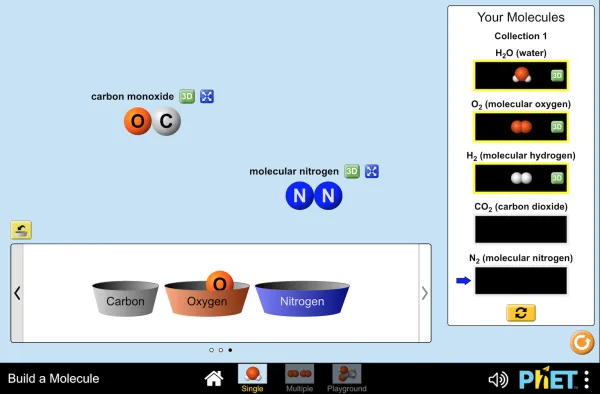
Build a Molecule
Full screen · PhET Interactive Simulations, University of Colorado Boulder, CC BY 4.0
Recap
- Elements contain one kind of atom; compounds have different elements chemically bonded.
- A molecule is a bonded group of atoms and can be an element (O₂) or a compound (CO₂).
- Metals lose electrons to form cations; non-metals gain electrons to form anions.
- Ionic compounds are lattices of oppositely charged ions in a ratio that makes the total charge zero.
- Polyatomic ions keep their group together and go in brackets when you need more than one.
- Non-metals share pairs of electrons in covalent bonds, which build molecules.
Challenge
A metal M forms a sulfate with the formula M₂(SO₄)₃. Sulfate is SO₄²⁻. (a) What is the charge on the M ion? (b) Write the formulas of the oxide and the nitrate of M. (c) How many atoms in total are in one formula unit of M₂(SO₄)₃?
Hint
Work backwards: the compound has no overall charge, so the total positive charge on the two M ions must cancel three sulfate ions.
Answer
(a) M³⁺ (b) M₂O₃ and M(NO₃)₃ (c) 17 atoms
Step by step
- Three sulfate ions carry 3 × (−2) = −6, so the two M ions must carry +6 between them.
- So each M ion is M³⁺.
- With O²⁻, the charges 3 and 2 meet at 6: two M³⁺ and three O²⁻ give M₂O₃.
- With NO₃⁻, one M³⁺ needs three nitrate groups, kept whole in brackets: M(NO₃)₃.
- Atoms in M₂(SO₄)₃: 2 M, 3 S and 3 × 4 = 12 O, so 2 + 3 + 12 = 17.
Full working
- 3 × (−2) = −6three sulfate ions
- 2 × (+3) = +6two M ions must cancel −6
- M³⁺ + O²⁻: 2 × (+3) + 3 × (−2) = 0 → M₂O₃lowest common multiple 6
- M³⁺ + NO₃⁻: (+3) + 3 × (−1) = 0 → M(NO₃)₃brackets keep nitrate whole
- 2 M + 3 S + 12 O = 17the 3 outside the bracket multiplies S and O
- (a) M³⁺ (b) M₂O₃, M(NO₃)₃ (c) 17
Ammonium phosphate is a garden fertiliser. Phosphate is the polyatomic ion PO₄³⁻ and ammonium is NH₄⁺. (a) Write its formula. (b) How many atoms of each element, and how many atoms in total, are in one formula unit? (c) A student writes NH₄₃PO₄. Explain what is wrong.
Hint
Treat each polyatomic ion as one unit with one charge. How many +1 groups cancel one −3 group?
Answer
(a) (NH₄)₃PO₄ (b) 3 N, 12 H, 1 P, 4 O: 20 atoms (c) without brackets it reads as 43 hydrogen atoms
Step by step
- Phosphate carries −3 and each ammonium carries +1, so three ammonium ions cancel one phosphate.
- The ammonium group must stay whole, so it goes in brackets with the 3 outside: (NH₄)₃PO₄.
- The 3 multiplies everything in the bracket: 3 N and 3 × 4 = 12 H. Phosphate adds 1 P and 4 O.
- Total: 3 + 12 + 1 + 4 = 20 atoms.
- NH₄₃PO₄ has no brackets, so the subscript reads as 43 hydrogen atoms and only one nitrogen.
Full working
- NH₄⁺ and PO₄³⁻+1 group and −3 group
- 3 × (+1) + (−3) = 0three ammonium per phosphate
- (NH₄)₃PO₄brackets keep each NH₄ whole
- N: 3, H: 3 × 4 = 12, P: 1, O: 4the 3 multiplies the bracket
- 3 + 12 + 1 + 4 = 20total atoms
- (NH₄)₃PO₄, 20 atoms; NH₄₃ wrongly means 43 H
Element X has 3 more electrons than a neon atom (2,8). Element Y has 2 fewer electrons than an argon atom (2,8,8). (a) Give the electron arrangement and the ion formed by each. (b) Write the formula of the compound of X and Y and name the type of bonding. (c) Y also joins with hydrogen to make a molecule. Predict its formula and explain why the bonding in it is different from the bonding in the X and Y compound.
Hint
Find each atom's electron arrangement first. How many electrons does each need to lose or gain to look like a noble gas? Hydrogen needs one more electron to fill its first shell.
Answer
(a) X 2,8,3 forms X³⁺; Y 2,8,6 forms Y²⁻ (b) X₂Y₃, ionic (c) H₂Y, covalent: two non-metals share electron pairs
Step by step
- X has 10 + 3 = 13 electrons: 2,8,3. It is a metal (aluminium) and loses its 3 outer electrons to become X³⁺.
- Y has 18 − 2 = 16 electrons: 2,8,6. It is a non-metal (sulfur) and gains 2 electrons to become Y²⁻ with 2,8,8.
- Charges 3 and 2 meet at 6: two X³⁺ and three Y²⁻, so the formula is X₂Y₃ (Al₂S₃), held by ionic bonds in a lattice.
- Hydrogen and Y are both non-metals and both want to gain electrons, so neither gives one away.
- Y needs 2 more electrons and each H needs 1, so Y shares one pair with each of two H atoms: H₂Y (H₂S), with two single covalent bonds.
Full working
- X: 10 + 3 = 13 electrons → 2,8,3aluminium
- X loses 3 → X³⁺ (2,8)metal, positive ion
- Y: 18 − 2 = 16 electrons → 2,8,6sulfur
- Y gains 2 → Y²⁻ (2,8,8)non-metal, negative ion
- 2 × (+3) + 3 × (−2) = 0 → X₂Y₃ionic lattice
- Y shares 1 pair with each of 2 H → H₂Ycovalent, both non-metals
- X³⁺, Y²⁻; X₂Y₃ ionic; H₂Y covalent