
What your body needs: air, food and water
What this lesson covers
- Your body needs air, food and water to live, move and grow
- Food and water go in through your mouth
- Air goes in and out through your nose and mouth
- Your body gets rid of what it does not need
- Using labels and arrows to show what goes in and out
Three things you need
- Your body needs air, food and water every day.
- They keep you alive.
- They give you energy to run and play.
- They help you grow bigger.
Air in, air out
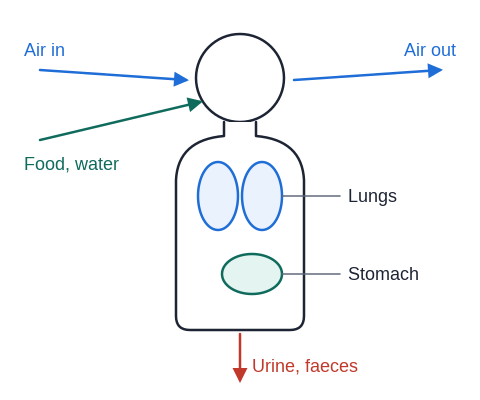
- You breathe air in through your nose and mouth.
- The air goes down into your lungs, inside your chest.
- Then you breathe the air out again.
- Put your hand on your chest and take a big breath. Feel your chest go up and down.
Food and water go in through your mouth
- You eat food and drink water through your mouth.
- Your teeth chew food into small soft pieces.
- When you swallow, food and drink go down a tube to your stomach.
Try it: lungs or stomach?
A map of what goes in and out
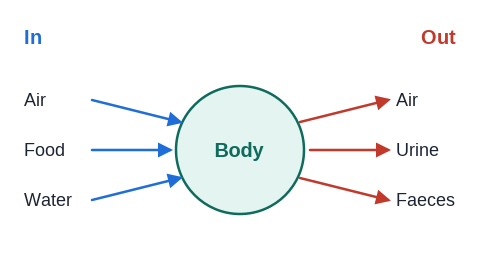
- Arrows show which way things move.
- An arrow pointing into the body shows something going in.
- An arrow pointing away shows something coming out.
- Labels name each thing that moves.
Getting rid of what you do not need
- Your body does not use everything that goes in.
- The air you breathe out carries away a gas your body does not need.
- Water your body does not need leaves as urine, or wee.
- Food your body cannot use leaves as faeces, or poo.
- Always wash your hands after you go to the toilet.
Try it: follow the trip
In or out?
- Decide if each one goes into the body or comes out: drinking milk, breathing out, going to the toilet.
- Drinking milk: into the body, through the moutha drink goes in
- Breathing out: out of the body, through the nose or mouthair comes out
- Going to the toilet: urine or faeces come outwaste leaves
- In, out, out
Try it: in or out?
Common mistakes
- When I swallow food, it goes into my lungs.Food goes down a tube to your stomach; only air goes into your lungs.
- I only need water when I feel thirsty.Your body needs water every day, and feeling thirsty means it already needs more.
- The air I breathe out is just the same as the air I breathe in.Breathed-out air carries away a gas your body does not need.
Count your breaths
You need: a clock or timer, paper, a pencil, a clear patch of floor
- Sit still. Ask an adult to time 1 minute while you count your breaths in.
- Write the number down.
- Jump up and down 20 times.
- Sit down and count your breaths for 1 minute again.
- Look for this: you breathe more after jumping, because your moving body needs more air.
Safety: Jump on a clear floor away from furniture with an adult nearby, and stop and rest if you feel dizzy or puffed.
Your turn
Which part of your body does food go in through?
Where does air go when you breathe in?
Breathing out: is that arrow into the body or out of it?
Name the three things your body needs every day.
How does water your body does not need leave it?
Show answer
1. The mouth. 2. Down into the lungs. 3. Out of the body. 4. Air, food and water. 5. As urine, or wee.
Recap
- Your body needs air, food and water to live, move and grow.
- Food and water go in through your mouth.
- Air goes in and out through your nose and mouth.
- Waste leaves your body as breathed-out air, urine and faeces.
- Arrows and labels show what goes in and what comes out.
Challenge
Sitting still, Tom counts 20 breaths in one minute. After jumping, he counts 30 breaths in one minute. How many more breaths did he take after jumping, and why?
Hint
Take the smaller number from the bigger one. Then think: what does a moving body need more of?
Answer
10 more breaths, because his moving body needs more air
Step by step
- 30 breaths after jumping, 20 sitting still.
- 30 − 20 = 10 more breaths.
- Jumping makes his body work hard.
- A working body needs more air, so he breathes faster.
Full working
- 30 − 20 = 10count back 2 tens
- moving bodyneeds more air
- 10 more breaths, his body needs more air
Maya draws a body with arrows. Her arrows say: food in, water in, air in, air out, wee out. One arrow is missing. Which one, and which way should it point?
Hint
Think about the three ways waste leaves the body.
Answer
Poo (faeces) out, pointing away from the body
Step by step
- Things going in: food, water and air. All are there.
- Waste coming out: breathed-out air, wee and poo.
- Breathed-out air and wee are there.
- Poo is missing. It comes out, so the arrow points away from the body.
Full working
- in: food, water, airall drawn
- out: air, wee, poopoo not drawn
- Poo (faeces) out, arrow pointing away
A diver swims under the sea for a short time. She carries a tank of air on her back, but she does not take any food or water with her. Why does she need the air but not the food?
Hint
How long can you hold your breath? How long can you wait for lunch?
Answer
Her body needs air all the time, but it can wait a little while for food and water
Step by step
- Your body needs air, food and water.
- You breathe in and out all the time, every few seconds.
- There is no air to breathe under the water, so she must bring her own.
- You eat and drink only a few times a day, so a short dive is fine without food or water.
Full working
- airneeded every few seconds
- food and waterneeded a few times a day
- Air all the time, food and water can wait a short while